
OpenAI Launches ChatGPT for Excel With Financial Data Integrations

OpenAI has introduced ChatGPT for Excel in beta, enabling users to build and analyze spreadsheet models directly within workbooks. The release also adds financial data integrations from major providers such as FactSet and Dow Jones Factiva.

By Daniel Mercer Edited by Maria Konash Published:
OpenAI Launches ChatGPT for Excel With Financial Data Integrations
OpenAI launches ChatGPT for Excel with GPT-5.4 support and financial data integrations. Photo: OpenAI

OpenAI has launched ChatGPT for Excel in beta, introducing an add-in that embeds its AI assistant directly inside Microsoft Excel workbooks. The tool allows users to build spreadsheet models, update formulas, run scenario analysis, and generate insights using natural language prompts.

Powered by the new GPT-5.4 model, the add-in is designed to help analysts and finance professionals perform complex spreadsheet tasks faster while maintaining Excel’s native formulas and structure. Instead of manually building models or writing formulas, users can describe the task in plain language and have ChatGPT generate or modify spreadsheet logic directly in the workbook.

According to OpenAI, the feature enables users to analyze data across large spreadsheets, trace dependencies between cells and formulas, and identify errors or changes in model outputs. ChatGPT also links its explanations to specific spreadsheet cells, allowing users to verify how results were generated.

The system requires confirmation before editing workbooks and allows users to undo modifications, providing an additional layer of control for financial and analytical workflows.

OpenAI said the add-in aims to reduce time spent on manual tasks such as building models, reconciling spreadsheets, and debugging formulas. Analysts, accountants, and strategists can instead focus on interpretation and decision-making.

Early testing shows significant performance improvements for financial modeling tasks. On an internal investment banking benchmark measuring workflows such as building three-statement financial models, GPT-5.4 achieved an average score of 87.3% compared with 43.7% for earlier GPT-5 models.

Financial Data Integrations Expand ChatGPT’s Role in Research

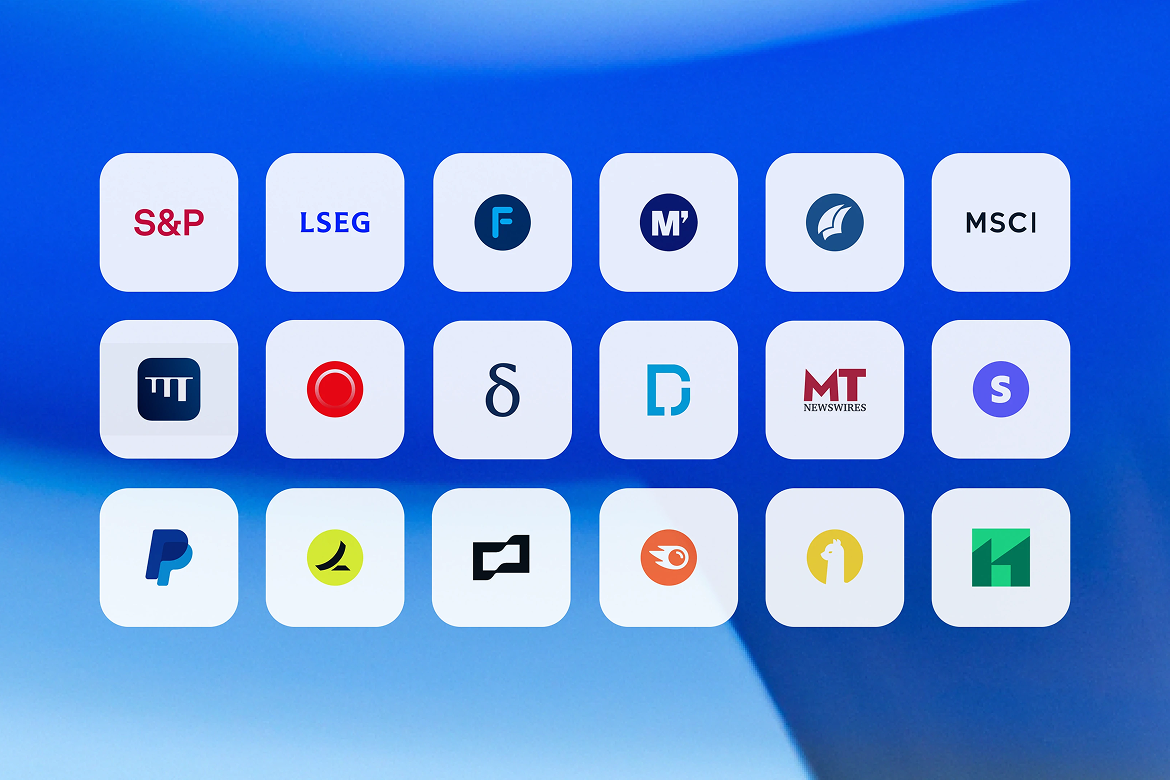
Alongside the Excel add-in, OpenAI introduced new financial data integrations directly within ChatGPT. These connectors allow users to access market and company data from providers including Dow Jones Factiva, LSEG, Daloopa, S&P Global, and other financial data platforms, with FactSet integration expected soon.

The integrations enable users to combine proprietary datasets with ChatGPT’s reasoning capabilities for research tasks such as earnings analysis, valuation modeling, and investment due diligence.

ChatGPT can generate structured outputs including earnings summaries, credit analyses, and valuation snapshots while citing underlying data sources. Teams can also export generated reports to formats such as Microsoft Word or PDF for documentation and internal reporting.

OpenAI said the integrations are part of a broader ecosystem of applications built on the Model Context Protocol, which allows organizations to connect proprietary data sources and internal systems to ChatGPT workflows.

Enterprise Security and Governance

The company emphasized that the new capabilities are designed for enterprise environments, particularly in regulated industries such as financial services. ChatGPT Enterprise includes role-based access controls, single sign-on integration, audit logs, and compatibility with common data security tools.

Data transmitted through the system is encrypted both in transit and at rest, and OpenAI said customer data shared with ChatGPT Enterprise is not used to train its models by default.

ChatGPT for Excel is initially rolling out in beta to Business, Enterprise, Education, Teachers, Pro, and Plus users in the United States, Canada, and Australia. OpenAI also said support for Google Sheets is expected in a future release.

The launch reflects a growing push by AI developers to embed generative models directly into professional software tools. By combining GPT-5.4’s reasoning capabilities with spreadsheet workflows and financial datasets, OpenAI aims to streamline research, modeling, and analysis tasks across banking, asset management, and corporate finance.


AI & Machine Learning, Consumer Tech, Enterprise Tech, News

Xiaomi Launches miclaw AI Agent Closed Beta in China

Xiaomi has launched a closed beta for miclaw, an AI agent powered by the MiMo large model that can control smartphones and smart home devices using natural language commands.

By Daniel Mercer Edited by Maria Konash Published:
Xiaomi launches the miclaw AI agent beta in China, enabling natural-language control of smart devices. Photo: Xiaomi

Xiaomi has announced the limited closed beta release of miclaw, a new AI agent designed to control smartphones and connected smart home devices using natural language commands. The system is powered by Xiaomi’s MiMo large language model and represents the company’s latest step toward integrating AI-driven automation into its mobile ecosystem.

The invitation-only beta is currently available in China for select flagship devices, including the Xiaomi 17 Ultra Leica Edition, Xiaomi 17 Ultra, Xiaomi 17 Pro Max, Xiaomi 17 Pro, and the standard Xiaomi 17.

Unlike traditional voice assistants that respond to predefined commands, miclaw is designed to understand user intent and execute multi-step workflows across apps and system tools. The agent can access more than 50 system utilities and ecosystem services to complete tasks automatically.

Xiaomi said the system can also analyze user behavior and provide recommendations based on device data. For example, the AI agent may review subscription expenses and suggest potential savings opportunities, or adjust device settings based on contextual information such as calendar events.

AI Architecture and Multi-Step Automation

The underlying architecture uses an inference-execution loop that processes user input, selects relevant tools, and executes tasks while monitoring outcomes in real time. This process allows the AI to handle complex requests while maintaining responsiveness on the device.

A key feature of the system is its three-tier memory architecture. The AI retains important decision points and compresses interaction history to maintain context across longer workflows, supporting up to 20 consecutive steps within a single task.

Through integration with Xiaomi’s HyperConnect ecosystem and Mi Home protocols, miclaw can control a wide range of connected devices. Users can manage smart home equipment such as lighting, air conditioners, security systems, and robotic appliances using natural language instructions.

The system also supports developer integrations through the Model Context Protocol and an open software development kit. Applications can declare their capabilities to the AI agent, allowing it to dynamically discover and use third-party features.

Privacy and Edge Processing

Xiaomi said the AI system was designed with strict privacy safeguards. Most processing occurs through edge-cloud computing that keeps sensitive data on the device whenever possible.

The company also stated that personal interaction data from miclaw will not be used to train its AI models.

The development also aligns with Xiaomi’s broader technology strategy. The company has said it plans to release a new smartphone processor each year and introduce an AI assistant for international markets as it expands its chip design capabilities and global AI ecosystem.

AI & Machine Learning, Consumer Tech, News

Everything You Should Know About OpenAI’s New GPT-5.4

OpenAI introduced GPT-5.4, a new frontier model combining advanced reasoning, coding, and agentic capabilities. The model brings improved tool use, computer interaction, and long-context performance across ChatGPT, the API, and Codex.

By Daniel Mercer Edited by Maria Konash Published:
OpenAI launches GPT-5.4 with stronger reasoning, coding, and computer-use capabilities. Photo: OpenAI

OpenAI has released GPT-5.4, its latest frontier artificial intelligence model designed to combine reasoning, coding, and agentic workflows into a single system. The model is rolling out across ChatGPT, the developer API, and OpenAI’s coding platform Codex, which has been launched for Windows just recently.

The company also introduced GPT-5.4 Pro, a higher-performance variant intended for complex professional workloads requiring deeper reasoning and higher accuracy.

“GPT-5.4 brings together the best of our recent advances in reasoning, coding, and agentic workflows into a single frontier model,” OpenAI said in its announcement.

The company added that the model is designed to help users complete complex professional tasks “accurately, effectively, and efficiently—delivering what you asked for with less back and forth.”

GPT-5.4 builds on recent advances from earlier models, integrating the coding capabilities of GPT-5.3-Codex with improvements in reasoning, tool usage, and professional productivity tasks. The model is designed to handle real-world work involving spreadsheets, documents, presentations, and complex multi-step workflows.

In ChatGPT, the GPT-5.4 Thinking mode introduces a planning feature that outlines the model’s reasoning approach before completing a response. According to OpenAI, the feature allows users to “adjust course mid-response while it’s working” to produce outputs more closely aligned with their needs. The update also improves deep web research capabilities and long-context reasoning for complex queries.

Benchmark results show measurable improvements over earlier models. On GDPval, a benchmark testing professional knowledge work across 44 occupations, GPT-5.4 matched or exceeded industry professionals in 83% of comparisons, compared with 70.9% for GPT-5.2.

Computer Use and Agentic Workflows

GPT-5.4 introduces native computer-use capabilities, allowing AI agents to interact with software environments and operating systems. The model can operate applications using keyboard and mouse actions, interpret screenshots, and execute workflows across multiple programs.

OpenAI described the release as “the first general-purpose model we’ve released with native, state-of-the-art computer-use capabilities.” The company said the feature enables developers to build agents capable of carrying out complex workflows across applications and websites.

On the OSWorld-Verified benchmark, which evaluates desktop navigation and computer interaction, GPT-5.4 achieved a 75% success rate. This represents a significant improvement over the 47.3% score recorded by GPT-5.2 and exceeds average human performance in the benchmark.

The model also improves visual reasoning and document parsing capabilities. On the MMMU-Pro benchmark measuring multimodal reasoning, GPT-5.4 reached 81.2% accuracy without tools. The model also introduces higher-fidelity image input support, enabling analysis of images up to 10.24 million pixels.

Coding and Developer Tools

GPT-5.4 incorporates the coding strengths of GPT-5.3-Codex while improving performance on longer-running development workflows. On the SWE-Bench Pro benchmark, which measures software engineering performance, GPT-5.4 achieved a score of 57.7% while maintaining lower latency compared with earlier models.

OpenAI also improved how models interact with external tools through a feature called tool search. Instead of loading every tool definition into the prompt, the system retrieves them dynamically when needed.

“This approach dramatically reduces the number of tokens required for tool-heavy workflows and preserves the cache, making requests faster and cheaper,” the company said.

Internal tests showed the feature reduced token usage by roughly 47% while maintaining the same accuracy.

In Codex, developers can also use a new experimental capability called Playwright Interactive, which allows the model to visually debug web applications and test software as it is being generated. OpenAI said the feature helps developers automate browser interactions and validate application behavior during development.

Availability and Pricing

GPT-5.4 is rolling out gradually across OpenAI’s platforms. In ChatGPT, GPT-5.4 Thinking replaces GPT-5.2 Thinking for Plus, Team, and Pro subscribers, while GPT-5.4 Pro is available to Pro and Enterprise users.

Developers can access the model through the API using the gpt-5.4 and gpt-5.4-pro endpoints. Pricing starts at $2.50 per million input tokens and $15 per million output tokens, reflecting the model’s expanded capabilities.

OpenAI said the release represents a major step toward more capable autonomous systems. By combining reasoning, coding, computer interaction, and tool use, GPT-5.4 is designed to support “more reliable agents, faster developer workflows, and higher-quality outputs across ChatGPT, the API, and Codex.”

The release also aligns with OpenAI’s broader push to expand its developer ecosystem. The company is reportedly developing a new code hosting platform that could compete with Microsoft-owned GitHub, reflecting a strategy to integrate AI models, coding agents, and developer infrastructure into a unified platform.

Amazon Launches Connect Health Agentic AI for Care Systems

Amazon introduced Connect Health, an agentic AI system designed to automate administrative tasks in healthcare. The platform integrates with electronic health records to assist with scheduling, documentation, and billing.

By Daniel Mercer Edited by Maria Konash Published:
Amazon launches Connect Health, an agentic AI platform that automates healthcare administration. Photo: Amazon

Amazon has introduced Amazon Connect Health, a new agentic AI platform designed to automate administrative work across healthcare systems. The solution integrates with electronic health records (EHRs) to help manage patient verification, appointment scheduling, documentation, and billing tasks.

Healthcare providers often face heavy administrative workloads that reduce time available for patient care. According to Amazon Web Services, healthcare staff can spend as much as 80% of call time compiling information across multiple systems when assisting patients. Administrative complexity has also affected patient experience, with surveys showing that scheduling challenges and long wait times are a common reason patients switch providers.

Amazon Connect Health is built to address these inefficiencies by automating routine interactions while maintaining human oversight. The system can interact with patients in natural language and assist with tasks such as verifying patient identity, checking insurance eligibility, reviewing provider schedules, and booking appointments during a single call.

The platform combines Amazon Connect, AWS’s AI-powered customer experience service, with real-time connections to EHR systems. When a request requires clinical expertise or human judgment, the system can transfer the interaction to staff based on rules defined by healthcare providers.

AI Support Across the Care Journey

Amazon designed Connect Health to support clinicians before, during, and after medical visits. Before an appointment, the system reviews patient medical histories and compiles summaries that highlight relevant conditions, recent events, and long-term trends.

During visits, with patient consent, the AI can transcribe conversations between clinicians and patients and generate draft clinical notes in real time. Each element of the documentation can be traced back to the specific part of the conversation where it originated.

After the appointment, the platform generates patient-friendly summaries and prepares medical codes needed for insurance billing. The system links suggested codes to source evidence in medical records or conversation transcripts, allowing clinicians to review and finalize them quickly. According to Amazon, the process can reduce the time required to prepare billing documentation from hours or days to minutes.

Early deployments show measurable results. UC San Diego Health, which manages more than 3 million patient interactions each year, reported saving about one minute per call and redirecting roughly 630 hours per week from patient verification tasks to direct assistance. The health system also saw call abandonment rates decline by about 30%, with some departments reporting reductions of up to 60%.

Amazon One Medical has also deployed the technology across more than one million patient visits, using ambient documentation features to streamline clinical workflows.

Security and Responsible AI Design

Amazon said the system was built with healthcare-specific safeguards and privacy protections. AWS offers more than 130 HIPAA-eligible services and compliance certifications designed for healthcare organizations.

Amazon Connect Health uses evidence mapping, a feature that links AI-generated outputs to their original sources, such as conversation transcripts, medical records, or billing guidelines. The transparency allows clinicians to audit recommendations and verify information before finalizing documentation.

The AI models powering the platform were trained using healthcare-specific datasets and evaluated using multiple safety and accuracy checks, including clinician oversight and automated evaluation systems.

Amazon said the goal of Connect Health is to reduce administrative friction for providers while improving patient access to care, enabling clinicians to spend more time with patients and less time on documentation and scheduling tasks.

AI & Machine Learning, News

Google Expands AI Mode Canvas to All US Search Users

Google has rolled out Canvas in AI Mode to all U.S. users in English, enabling people to create documents, dashboards, and interactive tools directly within Search. The feature provides a dynamic workspace for planning projects and building simple applications.

By Daniel Mercer Edited by Maria Konash Published:
Google launches Canvas in AI Mode for U.S. Search, enabling interactive documents, dashboards, and coding tools directly in AI results. Photo: Google

Google has expanded its Canvas feature within AI Mode in Search to all users in the United States using English. The feature introduces a dedicated workspace that allows users to create documents, build tools, and organize projects directly inside Google’s AI powered search interface.

Canvas functions as a dynamic side panel where users can draft content, develop interactive tools, and manage ongoing projects. The workspace integrates live information from the web and Google’s Knowledge Graph to populate projects with updated data.

The rollout marks another step in Google’s effort to transform search from a traditional query interface into a broader productivity environment powered by generative AI.

Users can access Canvas through the AI Mode tool menu and describe the project or tool they want to create. The system then generates a working prototype inside the Canvas panel, which can be edited and refined through conversational prompts.

Interactive Tools and Coding Capabilities

The updated Canvas environment includes expanded capabilities for both creative writing and coding tasks. Users can draft documents, create dashboards, or build lightweight applications without leaving the Search interface.

One example shared by Google involved an academic scholarship dashboard that aggregates application requirements, deadlines, and award amounts into a single interactive tool. Similar use cases could include study planners, travel itineraries, or data tracking dashboards.

For more advanced users, Canvas also allows access to the underlying code powering generated tools. Developers can view and modify the code directly, enabling customization or further refinement of generated applications.

Google said the feature was designed to support iterative development. After generating an initial prototype, users can test functionality and request changes through follow up prompts until the tool or document meets their needs.

AI Search as a Productivity Platform

The introduction of Canvas reflects a broader shift in how technology companies are positioning AI assisted search as a platform for creation rather than just information retrieval.

By integrating writing, coding, and project management capabilities into the search experience, Google is competing more directly with AI assistants that function as productivity tools.

The move also aligns with the industry trend toward embedding generative AI into everyday workflows. Rather than requiring separate applications for coding, note taking, or research, platforms like Canvas aim to consolidate those tasks within a single interface powered by AI models and real time web data.

AI & Machine Learning, Consumer Tech, News

Anthropic CEO Criticizes OpenAI Defense Deal as “Safety Theater”

Anthropic CEO Dario Amodei criticized OpenAI’s Pentagon agreement in a memo to staff, calling the company’s safety commitments “safety theater.” The remarks highlight deepening tensions between AI firms over military use of their technology.

By Samantha Reed Edited by Maria Konash Published:
Anthropic CEO Dario Amodei calls OpenAI’s Pentagon deal “safety theater,” intensifying the debate over military AI safeguards. Photo: Rob Laughter / Unsplash

Anthropic Chief Executive Dario Amodei has criticized OpenAI’s agreement with the U.S. Department of Defense, describing the company’s safety commitments as “safety theater” in a memo to employees. The comments, reported by The Information, reflect escalating tensions between leading AI developers over how their technology should be used in military contexts.

The dispute follows failed negotiations between Anthropic and the Pentagon over the military’s access to the company’s AI systems. Anthropic had previously secured a $200 million contract with the Department of Defense but declined to expand the partnership after the agency requested broader access to its technology.

According to people familiar with the talks, Anthropic asked the government to formally confirm that its models would not be used to enable mass domestic surveillance of U.S. citizens or to power fully autonomous weapons systems.

When the companies could not reach an agreement, the Pentagon instead signed a deal with OpenAI to deploy its AI models across defense infrastructure.

Debate Over Safeguards and “Lawful Use”

OpenAI said its contract with the Defense Department includes safeguards that align with similar restrictions proposed by Anthropic. The company stated that its systems would not be intentionally used for domestic surveillance of U.S. persons and that the agreement explicitly acknowledges those limitations.

However, Amodei argued in his memo that OpenAI’s messaging misrepresents the situation. He wrote that OpenAI accepted the agreement largely to avoid internal employee pushback rather than to enforce meaningful safeguards.

Amodei also criticized the contract language allowing AI systems to be used for “all lawful purposes,” a phrase Anthropic had rejected during negotiations. Critics have pointed out that legal frameworks can evolve, meaning activities considered unlawful today could become permissible in the future.

OpenAI responded in a blog post that the Defense Department has stated it does not intend to deploy AI for mass surveillance of Americans or for fully autonomous weapons systems.

Industry and Public Reaction

The dispute has become one of the most visible public disagreements among leading AI companies over military deployments of generative AI technologies.

Amodei suggested in his internal message that public sentiment may be shifting in Anthropic’s favor. Data from market intelligence firms showed a sharp increase in ChatGPT app uninstallations after OpenAI announced its Pentagon agreement, while Anthropic’s Claude application climbed in download rankings.

The controversy also unfolds as OpenAI explores further defense partnerships beyond the United States. The company is considering a deal to deploy its AI models across NATO’s unclassified networks following its Pentagon agreement, highlighting how Western defense organizations are increasingly integrating generative AI systems even as debates intensify within the industry over safeguards and governance.

AI & Machine Learning, News
Exit mobile version