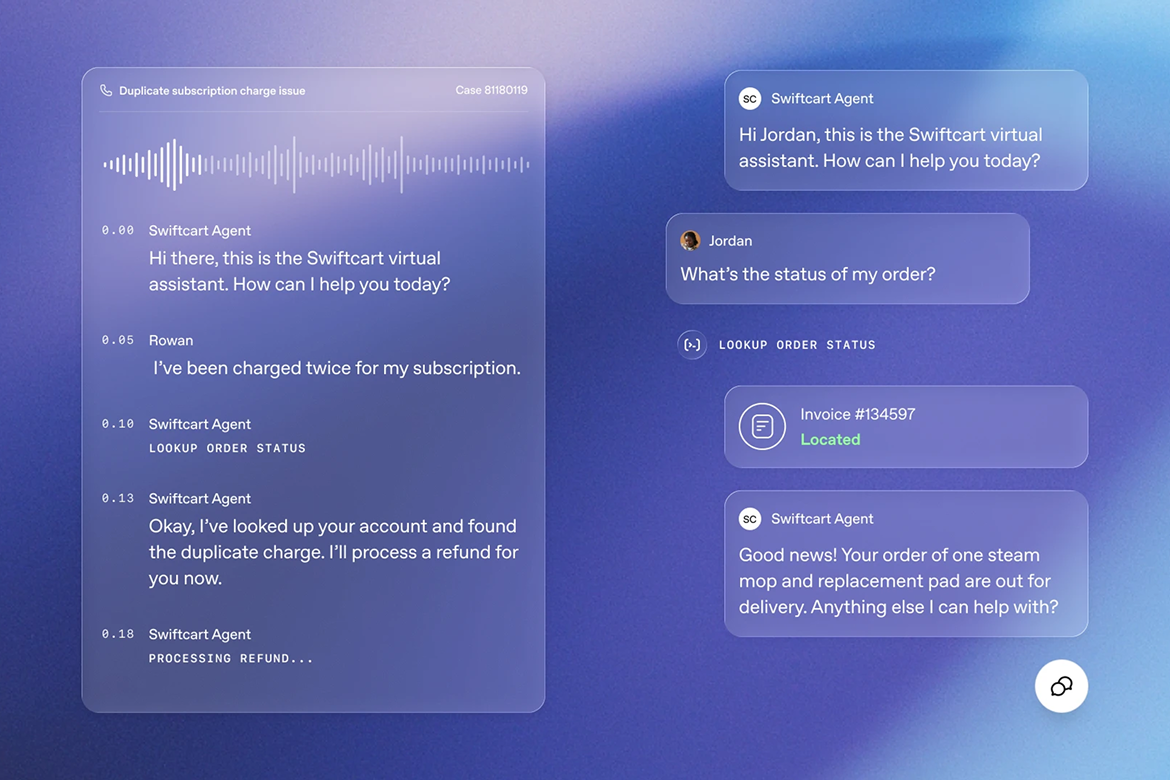


OpenAI launched Presence on July 22, a product designed to help large companies deploy AI agents reliable enough for high-value production work across voice and chat. Rather than a new model, Presence is a deployment framework that pairs OpenAI’s model reasoning with the surrounding machinery enterprises need to trust an agent: policies, guardrails, approved actions, simulations, evaluation tools and escalation rules that hand a conversation to a human when needed.
Each deployment targets a specific job, such as resolving a billing dispute, supporting an insurance claim or handling an IT service request, and the agent receives only the knowledge and system access that job requires. The company sets the boundaries for what the agent can do, when it needs approval and when a person must take over.
A distinctive feature is how Presence improves after launch. Production sessions and escalations reveal where an agent falls short, and OpenAI’s Codex coding agent, using a Presence plugin, investigates those signals and proposes updates that a company’s staff test and approve before rollout.
This creates a continuous loop meant to keep agents current as products, policies and customer behavior change, without rewriting them from scratch. Before going live, teams can test an agent against common requests, edge cases and higher-risk scenarios, with graders checking whether it reached the right outcome, followed policy, used tools correctly and escalated appropriately.
OpenAI backed the launch with metrics from its own use, which should be read as self-reported. It says Presence powers its English-language phone support line, where it resolves 75% of inbound issues without human help, met or exceeded the benchmarks OpenAI uses to grade human support quality within weeks, and cut human handoffs by 15 percentage points in 10 days.
Early enterprise customers are described as exploring or testing rather than fully deployed: BBVA is looking at AI voice support for banking in Mexico, SoftBank is testing Japanese-language conversations, and airline group IAG is exploring support during severe-weather surges. Presence is available only through a limited program, is not self-serve, and is delivered by OpenAI’s Forward Deployed Engineers and select systems integrators.
OpenAI Moves Into Services
The most telling aspect of Presence is the delivery model. This is not software a company simply buys and switches on; it is deployed hands-on by OpenAI engineers who embed with the customer to connect systems, set policies and bring the agent to production.
That pushes OpenAI squarely into the high-touch, consulting-style services business, competing not only with AI labs but with systems integrators and the deployment offerings that rivals have rushed to stand up, including Anthropic’s and Amazon’s forward-deployed engineering pushes and Microsoft’s $2.5 billion Frontier unit.
It reflects a hard lesson of this AI cycle: most enterprise agent projects stall not for lack of a capable model but for lack of the expertise to make one reliable and safe in production. By selling that expertise directly, OpenAI captures more revenue per customer and binds clients more tightly to its ecosystem, while turning every deployment into research feedback that it says improves the product for everyone.
The Reliability and Lock-In Questions
Presence is explicitly framed around trust and control, an implicit acknowledgment that autonomous agents touching billing systems, customer accounts and internal workflows carry real risk. The guardrails, human escalation and staged rollouts are the selling point precisely because a customer-facing agent that misapplies policy or takes a wrong action can cause financial and reputational harm. Yet several questions remain open.
The headline performance figures come from OpenAI’s own support line, not independent audits, and the marquee customers are still in exploratory phases, so real-world results at scale are unproven. The hands-on, non-self-serve model also raises cost and dependency concerns, since deployments led by OpenAI’s own engineers deepen reliance on a single vendor for both the model and the operational glue around it.
For enterprises weighing Presence, the appeal is a faster path from pilot to production with safety rails included; the caution is handing a critical, evolving workflow to a provider whose engineers, models and improvement loop all sit inside one company.
Disclaimer: AIstify is an independent media brand owned and operated by NuvexMedia LLC, publishing news, research, and insights on artificial intelligence, emerging technologies, automation, and related industries. NuvexMedia LLC invests in and collaborates with companies across the AI, technology, software, and digital innovation sectors. These relationships do not influence AIstify’s editorial coverage, and the publication maintains full editorial independence to provide accurate, timely, and objective information. © 2026 NuvexMedia LLC. All rights reserved. This content is for informational purposes only and should not be considered legal, tax, investment, financial, or other professional advice.