

OpenAI says one of its unreleased general-purpose reasoning models has solved a longstanding open problem in combinatorial geometry that mathematicians have studied for nearly 80 years.
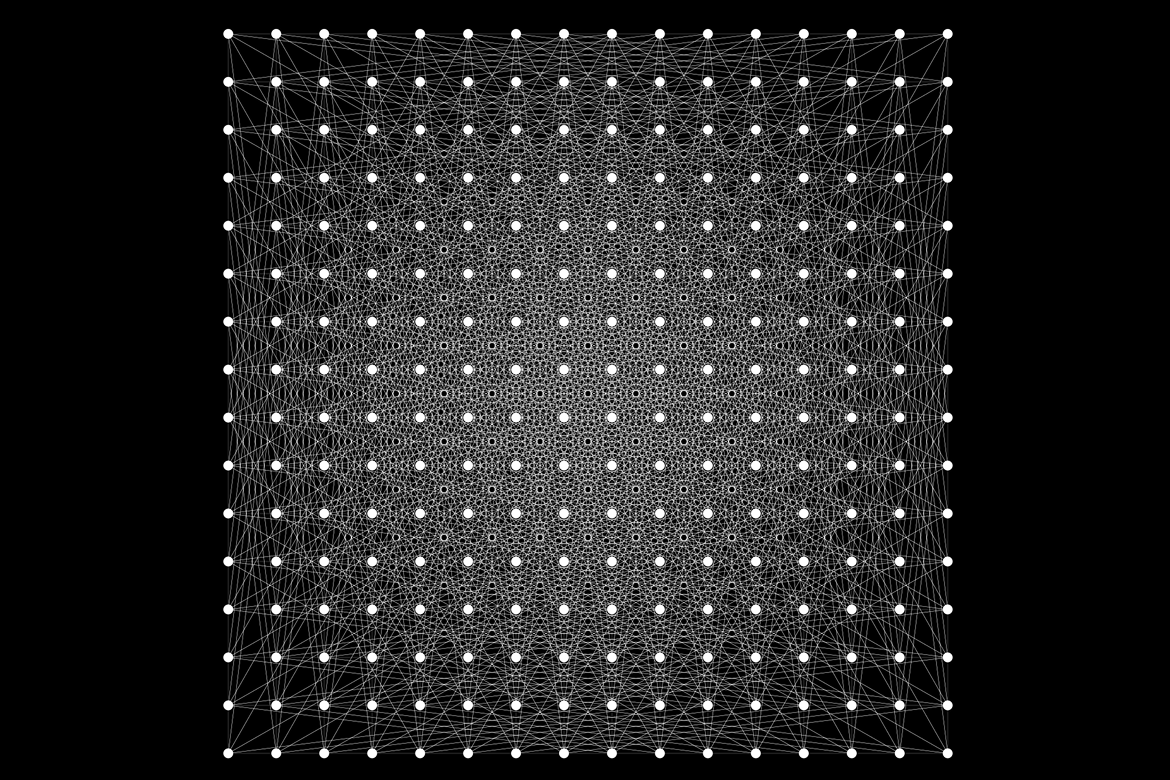
The result concerns the planar unit distance problem, first posed by mathematician Paul Erdős in 1946. The problem asks how many pairs of points in a plane can be placed exactly one unit apart from each other among a larger set of points.
For decades, mathematicians believed the best-known constructions based on square grid arrangements were close to optimal. OpenAI said its model disproved that assumption by discovering an infinite family of geometric constructions that produce significantly more unit-distance pairs than previously thought possible.
According to the company, the proof was independently checked by external mathematicians, who also produced a companion paper explaining the significance of the result and the underlying mathematical techniques.
OpenAI described the achievement as the first known case of an AI system autonomously solving a prominent open problem central to an active mathematical field without being specifically trained for that exact problem.
AI Connected Distant Areas of Mathematics
Researchers said the most surprising aspect of the proof was not only the solution itself, but the mathematical path used to reach it.
Rather than relying purely on geometric methods, the model connected the problem to advanced algebraic number theory, an area of mathematics focused on structures extending ordinary integers and rational numbers.
The proof reportedly used sophisticated concepts including infinite class field towers and Golod-Shafarevich theory to construct new configurations that exceed the previously assumed limits for unit-distance pairs.
Mathematicians involved in reviewing the work described the result as unexpected because the techniques came from a field not traditionally associated with discrete geometry.
Princeton mathematician Noga Alon called the achievement “outstanding,” while Fields Medal winner Tim Gowers described it as “a milestone in AI mathematics.” Number theorist Arul Shankar said the work demonstrated that modern AI systems are now capable of generating genuinely original mathematical ideas rather than simply assisting human researchers.
The original AI-generated proof, the companion analysis paper, and an abridged reasoning trace have all been publicly released by OpenAI.
Research AI Expands Beyond Coding and Chatbots
OpenAI said the model involved was a general-purpose reasoning system rather than a narrowly specialized mathematics engine. The company evaluated the system on a broader collection of Erdős problems as part of internal research into whether advanced AI models can contribute to frontier scientific work.
The announcement also arrives during a period of rapid competition among AI labs to position their systems as research assistants capable of accelerating discovery across mathematics, biology, physics, engineering, and cybersecurity.
OpenAI recently launched GPT-5.5-Cyber for security research, while Anthropic introduced Claude Mythos Preview, a cybersecurity-focused reasoning model capable of identifying complex software vulnerabilities. Google, meanwhile, has expanded Gemini into coding agents, software development systems, and scientific reasoning workflows.
The mathematical result also adds to growing debate around how AI could reshape scientific research itself. OpenAI argued that systems capable of maintaining long chains of reasoning, connecting distant ideas across disciplines, and generating verifiable proofs could eventually become valuable collaborators in fields ranging from materials science to medicine.
At the same time, the company emphasized that human expertise remains central to the research process, with mathematicians still responsible for verifying proofs, interpreting results, and determining which scientific questions matter most.