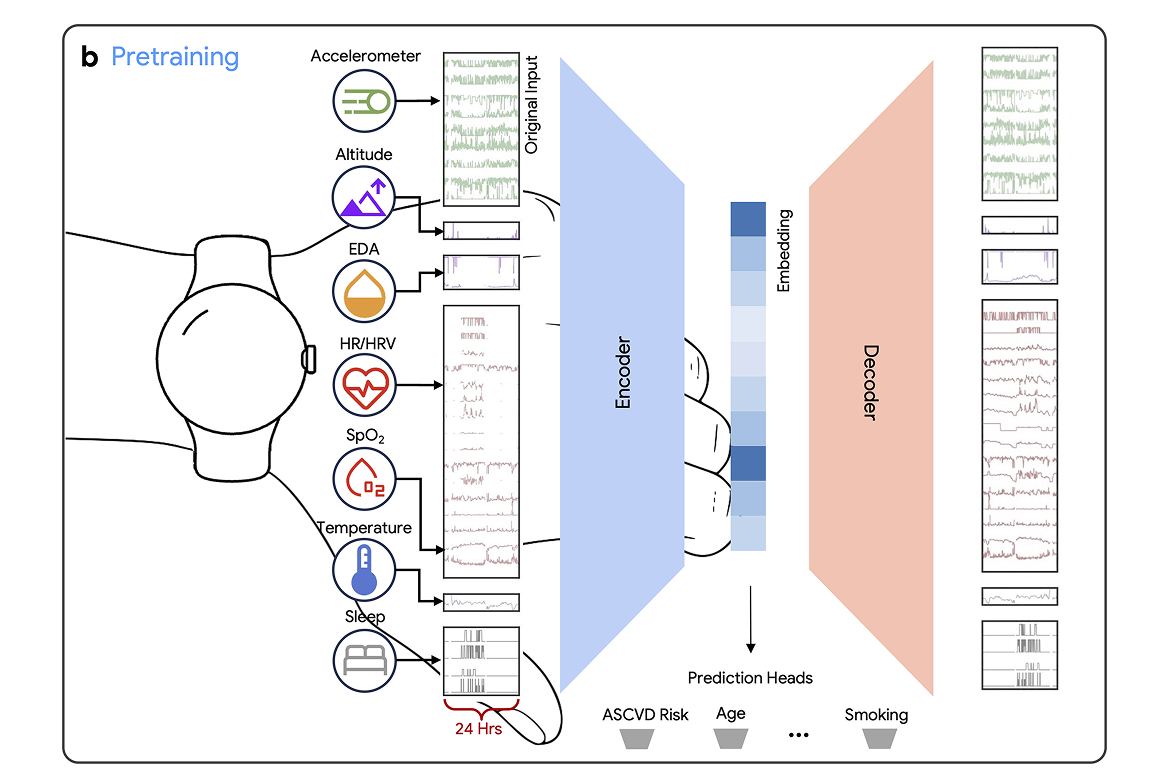


Google Research unveiled SensorFM, a foundation model for wearable health trained on more than one trillion minutes of sensor data drawn from five million consenting people. Described in a paper by lead author Girish Narayanswamy and 39 co-authors from Google Research, Google DeepMind and academia, the model analyzes signals like heart rate, skin temperature, sleep, blood-oxygen and movement to estimate more than 35 health-related measures, spanning cardiovascular health, metabolic risk, mental health, sleep, and lifestyle and demographic factors.
Google says it is the largest and most diverse wearable dataset used to train a model to date, gathered from over 100 countries, all 50 US states and more than 20 Fitbit and Pixel Watch models between September 2024 and September 2025.
The core innovation is applying the foundation-model approach, familiar from large language models, to physiological data. Instead of building a separate, laboriously labeled model for each condition, SensorFM learns a single general-purpose representation of human physiology from unlabeled data, which can then be adapted to many tasks.
It uses self-supervised learning, reconstructing masked portions of the sensor stream, and is deliberately designed to handle the fragmented, gap-filled data typical of real wearables, when a watch comes off the wrist or a sensor powers down, rather than discarding incomplete recordings. Google reports that scaling both the model and the dataset together produced steady, near-linear gains, with the largest version winning on 33 of 35 tasks and its embeddings beating engineered-feature baselines on 34 of 35.
The most striking result involves a personal health agent. When Google fed SensorFM’s predictions into an AI health coach and had clinicians blindly rate the resulting summaries, grounding the agent in the model’s inferences improved the responses on every measure over a baseline, and, notably, showed no statistically significant difference from grounding it in actual ground-truth clinical measurements.
In other words, for that test, the model’s estimates served the coach about as well as real lab results. Google also highlighted strength on hard-to-detect conditions like depression and anxiety, which leave only faint traces in sensor data.
Why It Points to a Shift
SensorFM signals where consumer health technology is heading: away from dashboards full of raw numbers and toward an AI layer that interprets those numbers into personalized guidance. The finding that a generalist model can approach labeled clinical data undercuts a decade-old assumption that each health prediction needs its own bespoke, expensively annotated dataset.
It also reveals a competitive moat, since a trillion-minute training corpus requires the kind of massive consumer-device ecosystem that only a handful of companies, Google, Apple and a few others, actually own. The broader trend is already visible in products like Whoop’s and Oura’s AI coaches, and SensorFM suggests the interpretation layer, not the sensor hardware, is becoming the real battleground, with Google’s ownership of Fitbit and the underlying models positioning it to lead.
The Cautions
Several important caveats temper the excitement. This is research, a preprint describing a model, not an approved medical device or a feature shipping to users, and its downstream evaluations ran on modest cohorts of roughly 14,000 participants across a handful of studies. The “as accurate as lab tests” claim is narrow, applying to how well the model grounded an AI coach’s summaries in one blinded evaluation, not a demonstration that a watch can replace clinical diagnosis. Wearable signals remain noisy and vary enormously between individuals, and estimating sensitive conditions like depression from wrist data raises real questions about false positives, medical liability and how such inferences might be used.
The privacy dimension is equally significant: building continuous physiological profiles from five million people, even de-identified and consented, concentrates deeply personal health data in one company’s hands, and turning always-on wearables into inferred medical monitors invites scrutiny over consent, accuracy and how those predictions could eventually feed insurance, employment or advertising systems. The science is a genuine advance; the path to trustworthy, regulated real-world use is longer.