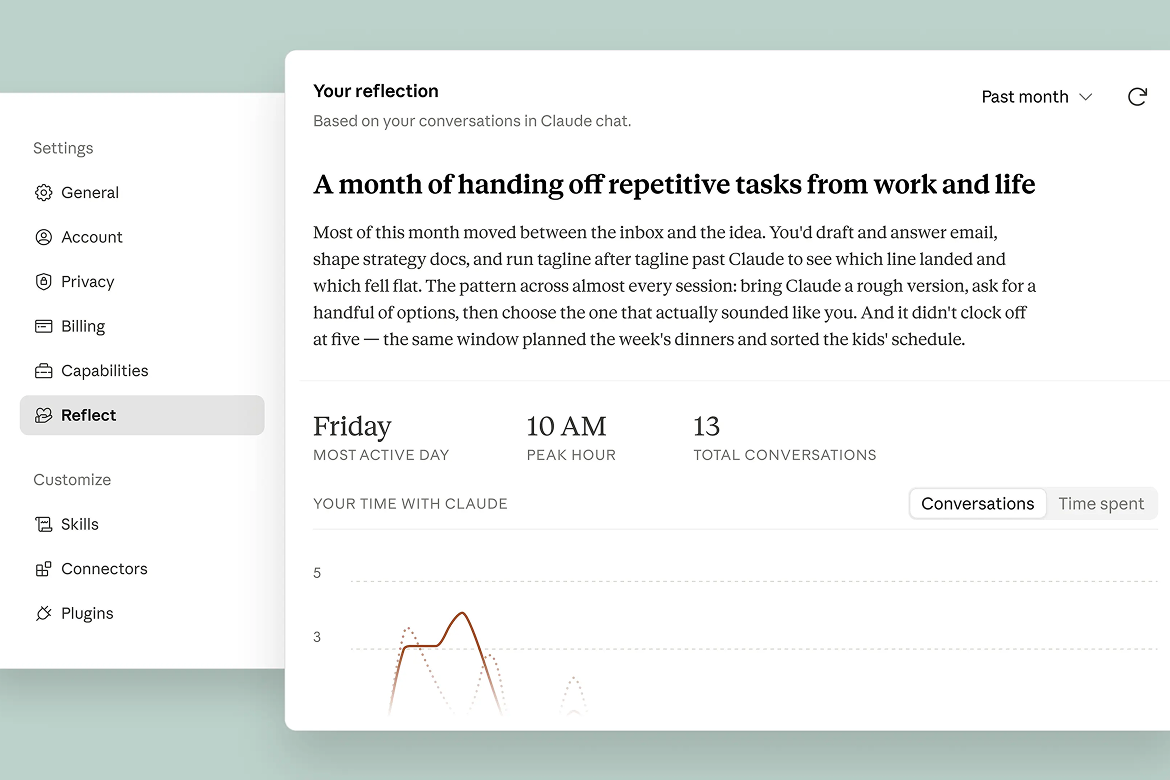


Anthropic launched a beta feature called Reflect, a dashboard that lets Claude users see how they have been using the chatbot and consider whether that time matches their goals. Found in the settings of Claude’s web and desktop apps, it opens with a written summary of recent conversations and shows patterns over the past one, three, six or 12 months, including most active days, peak hours, total chats and the topics and task types a person works on most.
Anthropic says the feature grew out of user interviews in which people expressed a desire to understand how, and how much, AI should fit into daily life. It is available to Free, Pro and Max users who have Claude’s memory feature enabled.
What distinguishes Reflect from a simple usage counter is its emphasis on intentional use. It periodically surfaces reflective prompts, such as asking what a user wants to keep doing themselves even if Claude could do it faster, and offers to talk the answer through. Users can set quiet hours or schedule a nudge to take a break after a period of use, both dismissible.
The dashboard also grades habits against Anthropic’s 4D AI Fluency Framework, which covers delegation, description, discernment and diligence, and offers practical tips, such as suggesting the Projects feature when it notices a user repeatedly re-explaining the same context. Anthropic developed the wellbeing elements with researchers from the MIT Media Lab, Boston Children’s Hospital’s Digital Wellness Lab and the Family Online Safety Institute.
On privacy, Anthropic drew clear boundaries. Reflect ignores incognito chats, does not pull in the underlying files from connected tools, so a summarized inbox might appear while the emails themselves do not, and excludes anything tied to a health integration.
Sensitive topics can surface, but only at a high level rather than in detail, and the company says the insights stay within the dashboard and are not used for other purposes. Notably, the tool does not yet show total time spent, which the company’s head of wellbeing policy said was a number the product team “didn’t want to maximize,” though it is coming later.
A Brake Pedal on Its Own Product
The obvious question is why an AI company would build a feature that can encourage people to use its product less. Anthropic’s stated answer is that better use beats more use, and the framing fits a brand built around AI safety and its “space to think” positioning that treats Claude as ad-free and not designed to maximize engagement.
That stance is a genuine differentiator at a moment when rivals like OpenAI and Meta are pushing to embed AI ever deeper into daily life. Reflect is Anthropic’s most direct attempt yet to compete on trust and wellbeing rather than raw capability, an unusual bet in an industry that mostly optimizes for time spent.
The Retention Read
Critics see a second layer. TechCrunch and others noted that Reflect’s suggestion engine recommends only Anthropic’s own features, never competitors, and that laying out a month of everything Claude has done for someone can make the tool feel indispensable. Nudging users toward Projects deepens integration and raises the cost of switching, echoing how a 2012 Gmail stats tool quietly showed how central Gmail had become to users’ lives.
The tension is real and both readings can hold at once: a wellbeing feature and a retention feature can be the same feature. Reflect genuinely tries to make AI use more deliberate, and it keeps users inside Claude while they deliberate, turning personal usage data into one more reason to stay. Which effect dominates will depend on whether the break reminders and reflective prompts carry as much weight as the recommendations to use more of Anthropic’s ecosystem.