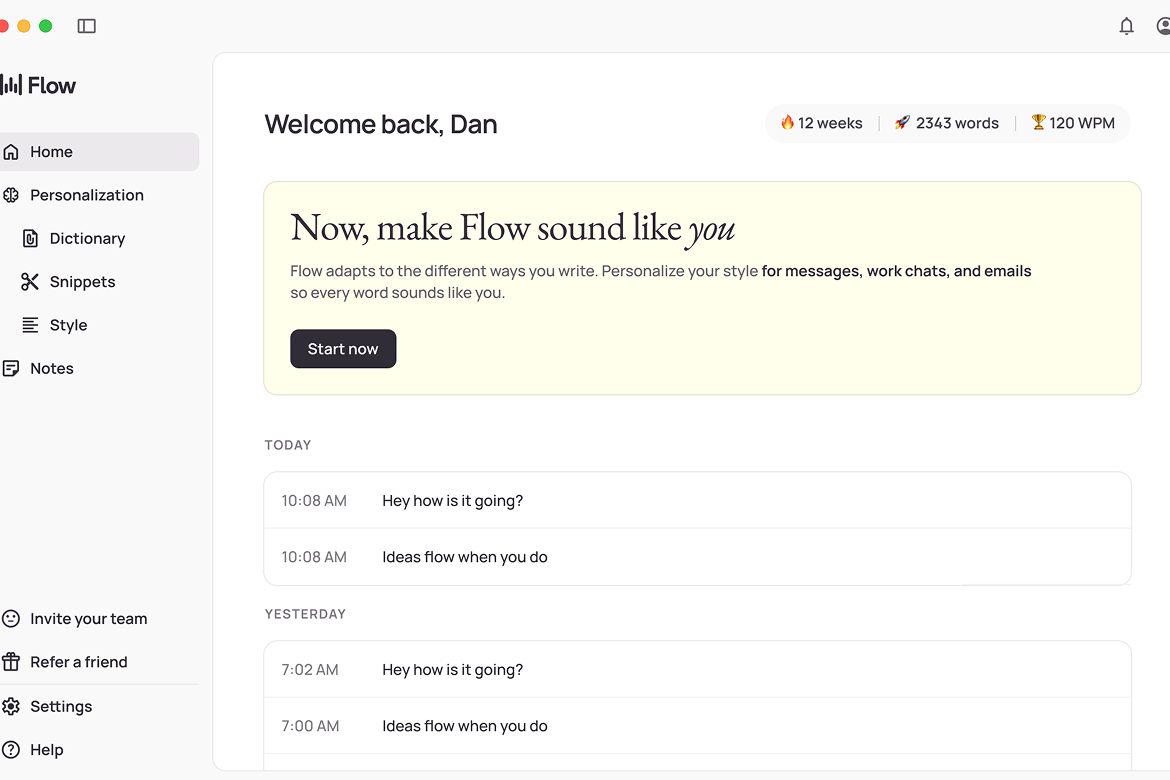


Voice AI company Wispr is riding a wave of strong traction, with its Wispr Flow dictation app becoming a staple for heavy users. The startup says that after three months, the average user writes more than half of all their characters through Flow. Wispr has also reached 270 of the Fortune 500 companies and signed 125 of them as enterprise customers.
Following a $30 million round in June led by Menlo Ventures, Wispr has now closed an additional $25 million led by Notable Capital, with participation from Steven Bartlett’s Flight Fund, TechCrunch has learned. This brings the company’s total funding to $81 million. Notable partner Hans Tung — an early backer of Affirm, Airbnb, Slack, Coinbase, Anthropic, and TikTok — is joining Wispr’s board as an observer.
Wispr CEO Tanay Kothari said Wispr Flow has grown 40% month-over-month since June, helped by enthusiasm among both enterprise teams and venture investors. He noted that Wispr wasn’t actively fundraising, but Notable’s deep research and strong conviction made the additional raise compelling.
With the new capital, Wispr plans to expand internationally and accelerate hiring in machine learning to compete for top technical talent. The company is celebrating a 100x increase in user base year over year, maintaining 70% retention across 12 months. After early churn among non-technical users who didn’t realize Flow could work across multiple apps, the company redesigned its onboarding experience to highlight those integrations.
Wispr is also pushing beyond its current platform footprint. An Android version of Flow is on the way, with a beta expected by the end of the year and a full launch in Q1 2025. The team is investing in fully personalized voice models to lower transcription errors, claiming a 10% Word Error Rate—significantly lower than OpenAI’s Whisper and Apple’s native transcription.
Although Wispr is focused on consumer productivity for now, it is testing a closed API with select enterprises and hardware partners, with broader developer access expected next year. Competition in the dictation space remains fierce, with contenders like Willow, Aqua, Monologue, Talktastic, Superwhisper, and Betterdictation all gaining interest.
Notable’s Hans Tung said he believes Wispr is positioned to evolve far beyond dictation, potentially becoming a voice-first operating layer capable of automating workflows.