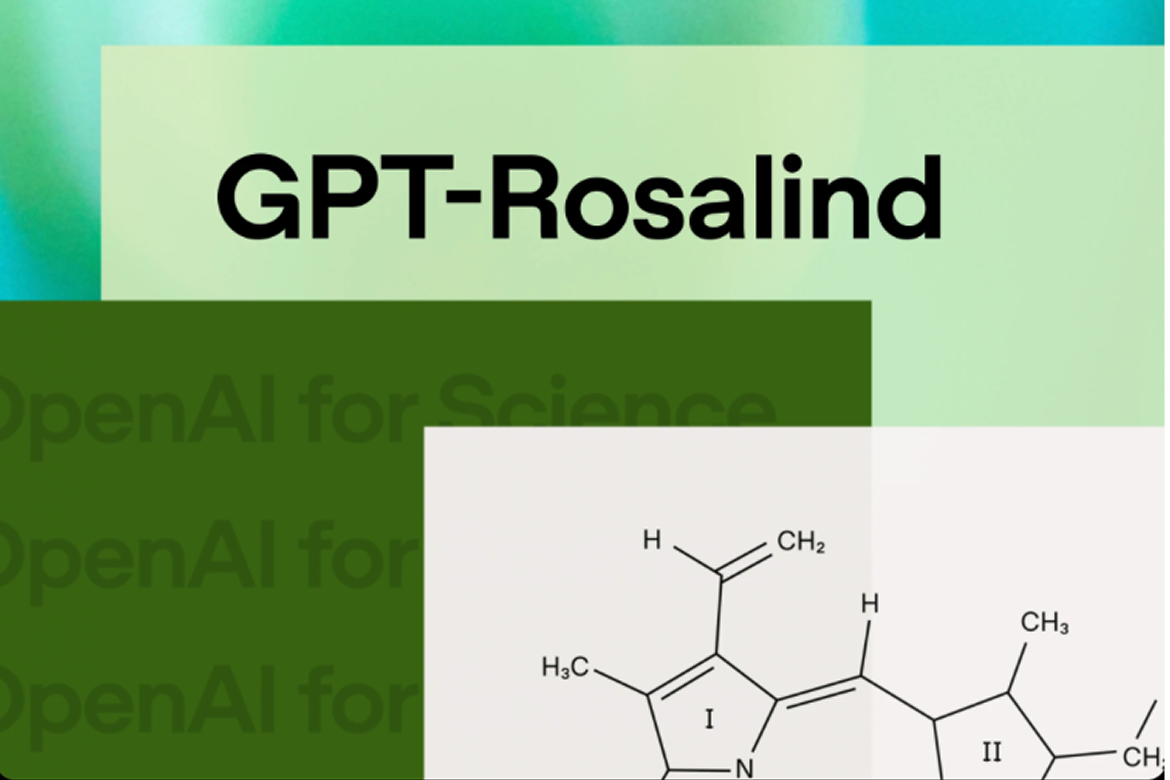

OpenAI has introduced GPT-Rosalind, a new domain-specific AI model designed to support research in biology, drug discovery, and translational medicine. The model is being released as a research preview through a controlled access program, reflecting both its advanced capabilities and the sensitivity of its potential applications.
GPT-Rosalind is built to address one of the most complex challenges in life sciences: the fragmented and time-intensive workflows that underpin early-stage discovery. Developing a new drug can take 10 to 15 years, with early research decisions having compounding effects on downstream outcomes. The model is designed to help scientists navigate large volumes of literature, datasets, and experimental variables more efficiently, while also generating and testing new hypotheses.
The system is available through ChatGPT, Codex, and the API for qualified enterprise users. OpenAI is also launching a Life Sciences research plugin for Codex, enabling integration with more than 50 scientific databases and tools. Early collaborators include major pharmaceutical and research organizations such as Amgen, Moderna, Allen Institute, and Thermo Fisher Scientific.
Built for Complex Scientific Workflows
Unlike general-purpose AI models, GPT-Rosalind is optimized for reasoning across specialized domains including chemistry, genomics, protein engineering, and disease biology. It is designed to assist with multi-step research tasks such as literature review, experimental planning, sequence analysis, and data interpretation.
OpenAI reports that the model shows improved performance on benchmarks related to biochemical reasoning, including protein structure analysis, phylogenetics, and experimental design. It also demonstrates stronger ability to use external tools and databases within complex workflows, a critical requirement for real-world scientific research.
In industry evaluations, GPT-Rosalind achieved leading results on bioinformatics benchmarks such as BixBench and outperformed earlier models on several tasks in LABBench2, including molecular cloning design. In collaboration with Dyno Therapeutics, the model also ranked above most human experts on certain RNA prediction tasks.
Controlled Access and Research Integration
Given the potential risks associated with advanced biological research tools, OpenAI is deploying GPT-Rosalind through a “trusted access” model. Organizations must meet criteria related to legitimate scientific use, governance, and security controls before gaining access. The rollout initially focuses on enterprise users in the United States.
The accompanying Life Sciences plugin provides an orchestration layer for scientific workflows, connecting researchers to public datasets, literature sources, and domain-specific tools. This allows the model to move beyond static responses and actively support research processes such as protein structure lookup, sequence search, and dataset discovery.
OpenAI said the system was developed with enhanced security measures and is intended for use in controlled research environments. During the preview phase, usage will not consume standard API credits, though safeguards are in place to prevent misuse.
The release marks the first step in a broader effort to build AI systems tailored to scientific discovery. OpenAI says future iterations will expand the model’s capabilities for long-horizon, tool-intensive workflows, with ongoing collaborations across academia, biotech, and national laboratories aimed at advancing areas such as protein and catalyst design.