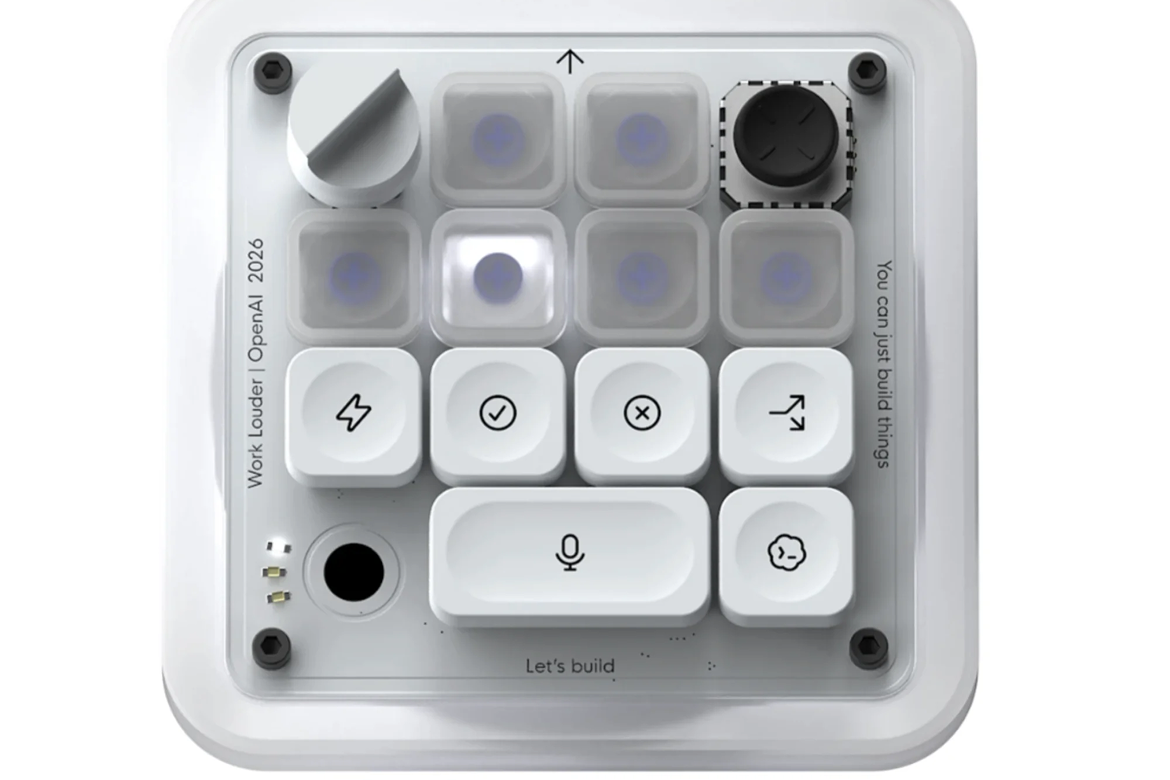

OpenAI has launched its first piece of consumer hardware to reach market, and it is a niche accessory rather than the mass-market gadget many expected. Codex Micro is a $230 mechanical keypad, developed with the peripheral maker Work Louder and sold through OpenAI’s new “Supply Co.” storefront as a “Work Louder Co-Lab” collaboration.
The compact 13-key controller is designed to sit beside a keyboard and give developers physical controls for Codex, OpenAI’s AI coding agent. Pre-orders are open now with an estimated ship date of July 24, confirming the details of a device OpenAI first teased in late June.
Meet kbd-1.0-codex-micro, built with @work_louder.
Map the buttons and joystick to your workflow, and keep your pinned chats in view.
Get yours before stock returns 410. pic.twitter.com/MGQQ1ISW0l
— OpenAI Developers (@OpenAIDevs) July 15, 2026
The hardware maps the repetitive actions of agent-driven coding onto dedicated physical inputs. It features a rotary dial to adjust the AI’s “reasoning level,” dialing how much thinking Codex applies to a task, a joystick to trigger workflows like reviewing pull requests or debugging errors, programmable command keys for actions such as accepting or rejecting the agent’s suggestions, and RGB backlighting that shifts color to reflect what an active Codex session is doing.
It ships with 32 interchangeable keycaps, connects over Bluetooth or USB-C, and works with Mac and Windows. The design is a rebadged version of Work Louder’s existing Creator Micro line, which let OpenAI enter hardware without building a device from scratch.
The launch stands in deliberate contrast to OpenAI’s far more ambitious hardware effort. The company is separately developing a screenless, “humanlike” AI companion speaker with former Apple design chief Jony Ive, whose startup io OpenAI acquired for roughly $6.5 billion, a device reported to track a user’s surroundings and habits and expected to ship in 2027.
OpenAI is effectively running two hardware tracks at once: a low-risk instrument for power users available now, and a mass-market consumer product still to come. Notably, the Ive collaboration is entangled in a trade-secret lawsuit Apple filed against OpenAI this month.
The Efficiency Play
Codex Micro is best read as a brand and loyalty move rather than a serious revenue business. By licensing a proven design and aiming it at Codex’s more than 5 million weekly users, OpenAI plants a physical anchor on a developer’s desk: a coder who grows used to summoning and steering Codex with a satisfying dial and joystick is less likely to switch to a rival tool.
It signals that OpenAI views developer experience, not just model quality, as a competitive edge, and it fits a small trend in AI coding where rivals like Cursor have handed out dedicated keys. The device turns a software habit into a tactile one, which is precisely its strategic value.
The Skeptic’s Case
The reaction online has been mixed, and the doubts are pointed. Some developers on Reddit questioned whether the release was a joke and called $230 steep for a peripheral serving a narrow set of workflows. The deeper tension is philosophical: AI coding is marketed on the promise of reducing the steps between intent and working software through plain language, yet a board of dedicated buttons adds hardware to a workflow built on natural language, arguably solving a problem the software already solved.
The category’s track record is also unforgiving, with standalone AI devices like Humane’s AI Pin and the Friend pendant both struggling badly after launch. Codex Micro sidesteps some of that risk by being an accessory rather than a standalone gadget, but whether developers actually want a physical controller for an agent they summon by typing remains the open question. The answer will not carry the weight OpenAI’s real hardware bet does; that verdict waits on the Ive device in 2027.