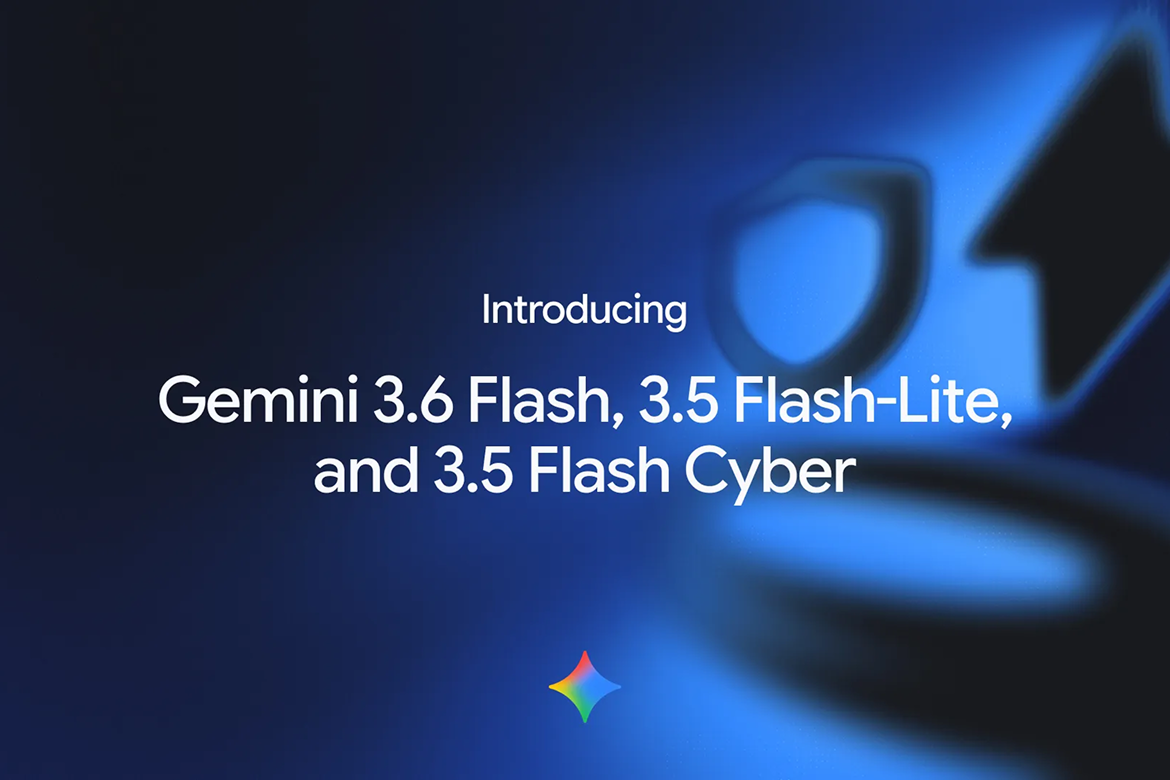


Google released three new Gemini models, all part of its efficiency-focused Flash line aimed at powering AI agents at scale rather than topping raw capability charts. The headline model, Gemini 3.6 Flash, is pitched as Google’s new workhorse for coding, knowledge work and multimodal tasks, and its main selling point is economy: Google says it uses 17% fewer output tokens than the 3.5 Flash model it replaces, takes fewer reasoning steps and tool calls, and costs less, at $1.50 per million input tokens and $7.50 per million output.
Alongside it, Google launched 3.5 Flash-Lite, its fastest and cheapest model at $0.30 and $2.50 per million tokens, running at about 350 tokens per second for high-volume tasks like search and document processing. Both are available now through the Gemini API, enterprise platform and consumer app.
The efficiency framing reflects where competition has moved. On Google’s own benchmarks, 3.6 Flash improves on its predecessor across coding, computer use and knowledge work, with the company citing gains such as 49% versus 37% on the DeepSWE coding test and a jump on a machine-learning research benchmark. These are self-reported figures drawn largely from the Artificial Analysis Index and Google’s internal evaluations, so independent confirmation matters.
The more striking claim is that the cheaper 3.5 Flash-Lite outperforms the older, larger Gemini 3 Flash on several agentic and coding tests, a sign of how quickly capability is trickling down to lower-cost tiers. The release notably arrives just a day after Google was reported to be designing a Gemini-specific efficiency chip, underscoring a coordinated push on cost per task.
The third model, Gemini 3.5 Flash Cyber, is the most consequential and the most restricted. Built on 3.5 Flash and fine-tuned to find, validate and patch software vulnerabilities, it is designed to run cheaply and in parallel inside Google’s CodeMender security agent, which invokes several Flash Cyber agents at once and merges their findings.
Google reports competitive results on the CyberGym benchmark and says that in one internal test on the V8 JavaScript engine, the setup found 55 unique confirmed issues, more than mainline Flash models or an older Anthropic Opus model managed. Because the same vulnerability-finding skill can serve attackers as well as defenders, Google is releasing Flash Cyber only to governments and trusted partners under a limited-access pilot.
The Vertical Slice Strategy
Rather than chase a single flagship, Google is segmenting its lineup into purpose-built tiers, a workhorse, a high-throughput lightweight model and a specialized security tool, each tuned for a specific cost-performance point.
The logic is that agentic systems make thousands of model calls, so shaving tokens and latency compounds into large savings, turning efficiency into the decisive competitive lever now that top models are converging in quality.
This is the same battleground where OpenAI’s cheaper GPT-5.6 tiers, Anthropic’s Claude Sonnet 5 and SpaceXAI’s Grok 4.5 are all competing, each promising near-frontier results at a fraction of the cost. Google is signaling it intends to win on price and integration across its API, enterprise platform and search, not on a single benchmark crown, while noting that Gemini 3.5 Pro is in partner testing and pre-training has begun on Gemini 4.
Why Safety Is Central
Flash Cyber’s gated release is the detail worth watching, because it reflects an emerging industry norm around offensive cyber capability. By restricting a capable vulnerability-finding model to vetted government and partner users, Google is following the same containment logic that led Anthropic to limit its Mythos model to select US institutions and OpenAI to stagger its GPT-5.6 rollout under government review.
The shared premise is that AI can now find security flaws faster than they can be fixed, which helps defenders but equally arms attackers, so frontier cyber tools are increasingly treated as controlled technology rather than open products. Google frames the pilot as giving defenders a head start while mitigating misuse, and pairs the consumer Flash models with strengthened safeguards against chemical, biological and cyber-offense abuse.
The approach is becoming standard, and with it a real tension: gating these tools may slow malicious use, but it also concentrates powerful defensive capability in the hands of a few, a trade-off the whole industry is now navigating.
Disclaimer: AIstify is an independent media brand owned and operated by NuvexMedia LLC, publishing news, research, and insights on artificial intelligence, emerging technologies, automation, and related industries. NuvexMedia LLC invests in and collaborates with companies across the AI, technology, software, and digital innovation sectors. These relationships do not influence AIstify’s editorial coverage, and the publication maintains full editorial independence to provide accurate, timely, and objective information. © 2026 NuvexMedia LLC. All rights reserved. This content is for informational purposes only and should not be considered legal, tax, investment, financial, or other professional advice.