OpenAI has begun testing advertisements inside ChatGPT in the United States, signaling a new phase in how the company supports free access to its AI tools. The test applies to logged-in adult users on the Free and Go subscription tiers. Users on Plus, Pro, Business, Enterprise, and Education plans will not see ads.
The company said ads will not influence ChatGPT’s responses and that conversations will remain private from advertisers. OpenAI framed the move as a way to fund infrastructure and ongoing development while preserving trust in ChatGPT for personal and professional use. The initial rollout is positioned as a learning phase, allowing the company to gather feedback before considering broader expansion.
How Ads Are Selected and Displayed
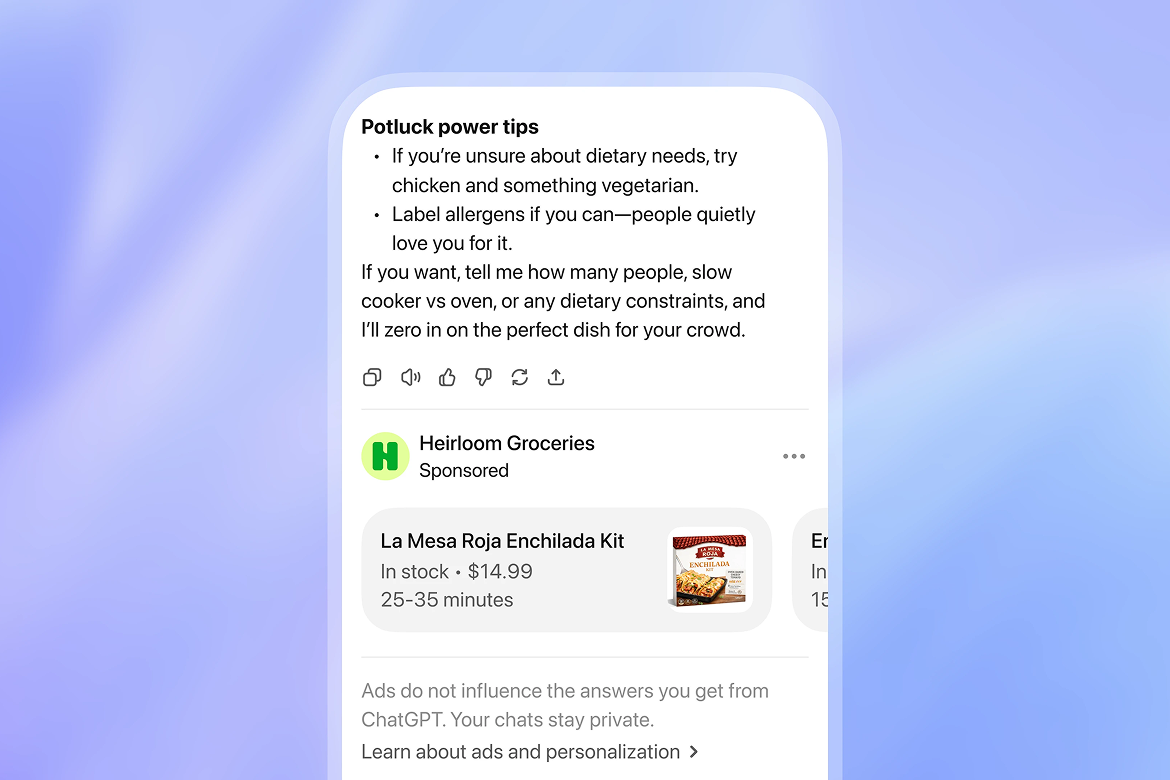
According to OpenAI, advertisements are clearly labeled as sponsored content and are visually separated from ChatGPT’s organic responses. Answers remain optimized solely for usefulness, not commercial outcomes. During the test, ads are selected by matching advertiser submissions with conversation topics, past chats, and prior interactions with ads.
For example, a user researching recipes might see an advertisement for grocery delivery or meal kits. When multiple advertisers are eligible, OpenAI selects the ad deemed most relevant to the conversation. The company emphasized that while topics may be matched to ads, the content of conversations is not shared with advertisers.
Users can opt out of ads by upgrading to paid plans or by choosing fewer daily free messages on the Free tier. OpenAI said this approach is intended to balance accessibility with sustainability as usage continues to grow.
Privacy and Safeguards
Privacy protections are central to the advertising test, OpenAI said. Advertisers do not receive access to user chats, chat histories, memories, or personal details. Instead, they are provided only with aggregated performance metrics such as impressions and clicks.
Ads will not be shown to accounts identified as belonging to users under 18. They are also excluded from appearing near sensitive or regulated topics, including health, mental health, and politics. OpenAI said these safeguards will evolve as the company learns from the test and refines its systems.
The company also said it is being selective about which advertisers are allowed to participate, with controls designed to limit scams and misleading promotions. Additional guardrails are intended to prevent overly narrow or intrusive ad targeting.
User Control and Long-Term Strategy
ChatGPT users will have tools to manage their ad experience, including dismissing ads, providing feedback, viewing ad history, deleting ad data, and adjusting personalization settings. These controls are accessible directly within the ChatGPT interface.
OpenAI said it views advertising in a conversational interface as potentially more useful than traditional formats. Because users often engage with ChatGPT while researching, planning, or comparing options, ads could help surface relevant products or services at the right moment.
The move places OpenAI’s approach in contrast with some competitors. Anthropic recently confirmed that its Claude AI assistant will remain ad-free, relying instead on subscriptions and enterprise contracts to generate revenue. The differing strategies highlight a growing divide in how AI companies balance monetization, user trust, and accessibility as conversational AI becomes more widely used. OpenAI said it believes advertising, if clearly separated from answers and designed with strong privacy protections, can coexist with unbiased AI responses. For now, the company said its priority remains learning from the test while keeping ChatGPT’s answers independent, conversations private, and users in control.